
Introduction
HDPE pipe manufacturing requires proper machine configuration, accurate tooling and stable extrusion conditions to produce pipes with consistent dimensions and quality. Among all the important components of an extrusion line, the die head plays a major role in determining the final pipe shape, wall thickness and material distribution. This makes HDPE Pipe Extrusion Die Selection an important decision for every pipe manufacturer.
An HDPE pipe extrusion die is responsible for distributing molten polyethylene around the mandrel and forming it into a continuous hollow pipe. The selection of the right die depends on several factors, including pipe diameter, wall thickness, material grade, extrusion capacity and production requirements.
Choosing an unsuitable die can create manufacturing problems such as uneven wall thickness, unstable melt pressure, rough pipe surfaces and dimensional variations. These problems can increase material consumption, production downtime and product rejection.
Manufacturers should therefore evaluate die design, flow-channel configuration, temperature control, tooling material and compatibility with the extruder before making a purchasing decision.
In this guide, we will explain different types of HDPE pipe extrusion dies, important selection factors, common die-related problems, maintenance practices and ways to improve overall pipe manufacturing performance.
What Is an HDPE Pipe Extrusion Die?
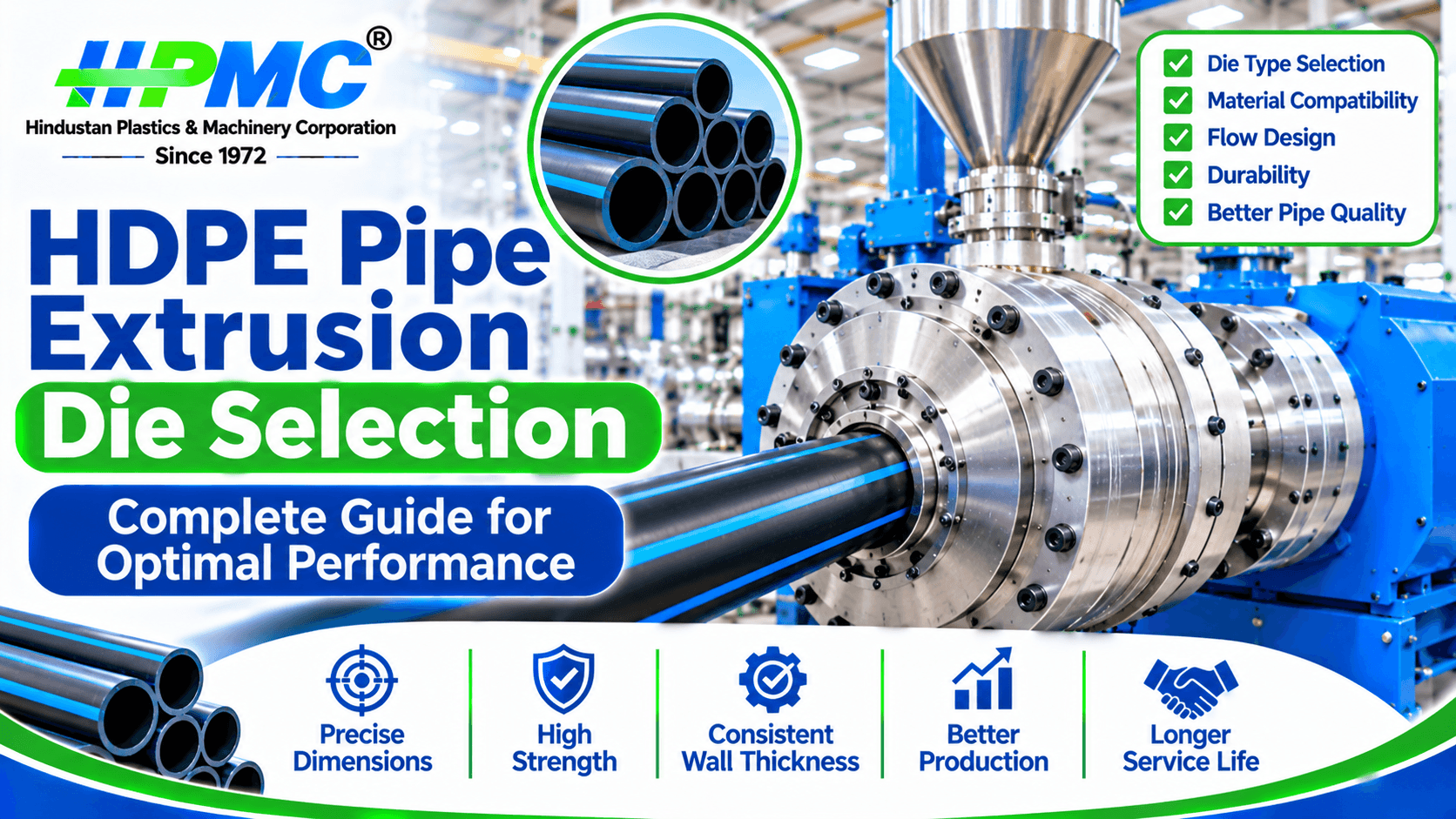
An HDPE Pipe Extrusion Die is a specialised tooling assembly installed at the outlet of an extruder. It receives molten HDPE material and distributes it around a mandrel to create a continuous pipe with the required dimensions.
The die assembly generally consists of a die body, mandrel, material distribution channels, heating arrangements and supporting components. Each component contributes to maintaining stable material flow during pipe formation.
The main functions of an HDPE pipe extrusion die include:
- Distributing molten HDPE uniformly around the mandrel.
- Forming the required pipe diameter.
- Supporting consistent wall thickness.
- Maintaining stable material flow.
- Producing a uniform pipe surface.
- Supporting continuous extrusion production.
The die must be compatible with the extruder and downstream equipment to achieve the required manufacturing results.
Why Is HDPE Pipe Extrusion Die Selection Important?
1. Uniform Wall Thickness
Proper die selection helps distribute molten polymer around the pipe circumference. Uniform material distribution supports consistent wall thickness and dimensional quality.
2. Better Pipe Dimensional Accuracy
The die must match the required pipe diameter and wall dimensions. Suitable tooling helps manufacturers achieve the intended product specifications.
3. Stable Melt Flow
A properly designed flow channel helps maintain consistent polymer movement through the die and reduces the risk of flow-related defects.
4. Reduced Material Wastage
Incorrect tooling can contribute to excessive material consumption and rejected pipes. Suitable die selection helps improve process control.
5. Improved Production Efficiency
A compatible die head can support stable extrusion conditions and reduce interruptions caused by unsuitable tooling.
6. Consistent Product Quality
Proper tooling and maintenance help manufacturers maintain repeatable production conditions across different manufacturing batches.
Types of HDPE Pipe Extrusion Dies
1. Spiral Die Head
A spiral die head uses specially designed spiral flow channels to distribute molten HDPE material around the mandrel. This arrangement helps achieve uniform material distribution and stable extrusion performance.
Spiral die heads are commonly considered for HDPE pipe production where consistent wall thickness and reliable output are important.
2. Basket Die Head
A basket die head uses a distribution arrangement that divides and recombines molten polymer before it reaches the die outlet. Its design helps distribute material around the pipe circumference.
The suitability of this configuration depends on the material, pipe dimensions and production requirements.
3. Spider Die Head
A spider die head uses supporting elements to hold the mandrel in position while polymer flows through separate passages.
The design requires consideration of material distribution and weld-line characteristics when selecting tooling.
4. Custom HDPE Pipe Die Head
Some manufacturers require special die configurations for particular pipe diameters, material grades or production capacities.
Custom tooling can be designed around the intended pipe specifications and extrusion machine configuration. Manufacturers should discuss the complete technical requirements with the equipment supplier before ordering.
Important Factors to Consider When Selecting an HDPE Pipe Extrusion Die
1. Required Pipe Diameter
Pipe diameter is one of the first factors to consider. The die must support the intended pipe diameter range and remain compatible with the sizing equipment.
Manufacturers producing different pipe sizes should evaluate the available tooling arrangements and size-change requirements.
2. Pipe Wall Thickness
Wall thickness affects material distribution and tooling requirements. The die should be designed to produce the required dimensions consistently.
Manufacturers should also consider the pipe SDR and applicable product specifications.
3. HDPE Material Grade
Different HDPE grades have different processing characteristics. The die should be suitable for the melt-flow behaviour and processing conditions of the selected material.
4. Extruder Output Capacity
The die must match the output capacity of the extruder. An unsuitable combination can affect melt pressure, material distribution and production stability.
5. Melt Flow Distribution
Uniform melt distribution is essential for producing pipes with consistent wall thickness. Evaluate the flow-channel design and material distribution around the mandrel.
6. Die Construction and Material
Die components should be manufactured using suitable materials and precision machining processes to withstand operating pressure, temperature and repeated production cycles.
7. Temperature Control
The die heating arrangement should provide stable temperature control. Temperature variations can influence polymer flow and pipe surface quality.
8. Maintenance Requirements
Manufacturers should check how easily the die can be opened, inspected, cleaned and reassembled. Accessible tooling components simplify regular maintenance.
9. Future Production Requirements
If you plan to expand your pipe manufacturing range, consider tooling flexibility and compatibility with additional pipe sizes.
How Does an HDPE Pipe Extrusion Die Work?
The HDPE pipe extrusion die operates as part of a continuous manufacturing process.
1. Raw Material Feeding
HDPE granules enter the extruder through a hopper or suitable feeding system.
2. Melting and Plasticisation
The rotating screw conveys and melts the polymer inside the heated barrel.
3. Melt Transfer
Molten HDPE moves towards the die head under controlled pressure.
4. Material Distribution
The die channels distribute molten polymer around the mandrel.
5. Pipe Formation
The material exits the die as a continuous hollow pipe.
6. Vacuum Sizing
The newly formed pipe enters the sizing section, where its external diameter and roundness are controlled.
7. Cooling
The cooling system removes heat and helps stabilise the pipe dimensions.
8. Haul-Off
The haul-off unit pulls the pipe through the production line at a controlled speed.
9. Cutting and Collection
The cutting machine separates the finished pipe into the required lengths.
All these stages must work together to maintain consistent pipe quality. Manufacturers can also understand the relationship between extrusion capacity and production speed through the HDPE Pipe Extrusion Line Output Calculation Guide.
Common HDPE Pipe Extrusion Die Problems and Solutions
1. Uneven Wall Thickness
Possible Causes: Incorrect die alignment, uneven melt distribution, tooling wear or unstable extrusion conditions.
Solutions: Inspect die and mandrel alignment, examine material flow channels and measure pipe thickness at multiple circumferential positions.
2. Rough Pipe Surface
Possible Causes: Unsuitable melt temperature, material contamination, unstable flow or deposits around the die outlet.
Solutions: Check processing temperatures, inspect raw material quality and clean the die according to the manufacturer's recommended procedure.
3. Melt Pressure Fluctuation
Possible Causes: Inconsistent material feeding, unstable plasticisation, filter restrictions or changing operating conditions.
Solutions: Review feeding consistency, monitor melt pressure and inspect the filtration system.
4. Die Lines on Pipe Surface
Possible Causes: Material deposits, scratches, damaged die surfaces or foreign particles.
Solutions: Inspect the die outlet, remove deposits safely and examine precision-machined surfaces for damage.
5. Pipe Diameter Variation
Possible Causes: Incorrect tooling dimensions, unstable vacuum sizing, inconsistent haul-off speed or cooling variations.
Solutions: Inspect the die and sizing system together. Check vacuum conditions and downstream speed synchronization.
6. Material Build-Up at Die Outlet
Possible Causes: Material degradation, contamination, unsuitable processing conditions or deposits during extended production.
Solutions: Follow the correct cleaning procedure, review temperature settings and inspect the material feeding system.
HDPE Pipe Extrusion Die Maintenance Checklist
Regular maintenance helps maintain tooling performance and reduce unexpected production interruptions.
Manufacturers should follow these practices:
- Inspect the die body and mandrel regularly.
- Check the die outlet for scratches and material deposits.
- Inspect heating elements and temperature sensors.
- Check heating-zone performance.
- Examine material flow channels during scheduled maintenance.
- Use suitable cleaning methods recommended by the manufacturer.
- Avoid damaging precision-machined surfaces.
- Verify die alignment after tooling installation.
- Maintain cleaning and maintenance records.
- Follow proper shutdown and safety procedures.
Die cleaning should only be performed after following the required shutdown, isolation and temperature-safety procedures.
How to Improve HDPE Pipe Quality Through Proper Die Selection
Selecting the right die is only one part of achieving consistent pipe quality. Manufacturers must also maintain suitable operating conditions throughout the extrusion process.
Maintain Consistent Extrusion Conditions
Stable material feeding, screw speed and temperature settings help maintain predictable melt flow.
Monitor Wall Thickness
Measure pipe thickness at different circumferential positions and compare readings with the applicable product specifications.
Maintain Proper Cooling
The cooling system must be suitable for the pipe dimensions and extrusion output. Manufacturers can explore the HDPE Pipe Cooling Tank Selection Guide for more information.
Synchronize Downstream Equipment
The haul-off, cooling and cutting systems should operate in coordination with the extruder to avoid unnecessary production variation.
Inspect Tooling Regularly
Routine die inspections help identify deposits, wear and alignment problems before they affect larger production batches.
For additional extrusion process guidance, manufacturers can also explore HPMC's Plastic Extrusion Hints.
How to Select the Right HDPE Pipe Extrusion Machine and Die Combination
Manufacturers should evaluate the extrusion machine and die head as one complete production system.
Before finalising the equipment, consider:
- Required pipe diameter range.
- Wall thickness and SDR requirements.
- HDPE material grade.
- Target production output in kg/hr.
- Extruder screw and barrel configuration.
- Die-head type and tooling range.
- Vacuum sizing and cooling capacity.
- Haul-off and cutting arrangement.
- Automation and control requirements.
- Technical assistance and spare-parts availability.
HPMC's High Speed HDPE Pipe Plant provides information about its extrusion equipment and production-line configuration.
The right machine and die combination should be selected according to actual production requirements rather than considering individual machine components separately.
Benefits of Choosing the Right HDPE Pipe Extrusion Die
A properly selected and maintained die can provide several manufacturing benefits:
- Better material distribution.
- More consistent pipe wall thickness.
- Improved dimensional control.
- Stable extrusion performance.
- Reduced material wastage.
- Lower risk of die-related surface defects.
- Easier production planning.
- Consistent finished pipe quality.
Actual results depend on die design, material properties, machine configuration and operating conditions.
Conclusion
HDPE Pipe Extrusion Die Selection is an important decision for manufacturers planning a new pipe production line or upgrading existing extrusion equipment. The die head controls how molten HDPE material is distributed and formed into a continuous pipe, making its design and compatibility essential for achieving the required product dimensions.
Manufacturers should evaluate pipe diameter, wall thickness, HDPE material grade, extruder output, melt-flow distribution, die construction, temperature control and maintenance requirements before selecting tooling.
A suitable die must also work in coordination with vacuum sizing, cooling, haul-off and cutting equipment. Regular inspection and preventive maintenance can help maintain stable production conditions and reduce tooling-related problems.
Before purchasing an HDPE pipe extrusion die, share your complete pipe specifications and production targets with the machinery manufacturer. This helps ensure that the proposed tooling is appropriate for your manufacturing requirements.
Contact Hindustan Plastics and Machinery Corporation (HPMC)
If you are planning a new HDPE pipe manufacturing plant or looking to upgrade your existing extrusion machinery, Hindustan Plastics and Machinery Corporation (HPMC) can help you explore suitable extrusion machinery solutions.
Discuss your required pipe diameter, wall thickness, HDPE material grade, production capacity and die-head configuration with the technical team to understand the appropriate machine setup.
Company: Hindustan Plastics and Machinery Corporation (HPMC)
Address: 5, Category II, DSIDC Industrial Area, Nangloi, Delhi – 110041, India
Phone: +91 95605 96392
Email: info@hindustanplastics.com
Website: https://www.hindustanplastics.com/
Request a Quote: Contact HPMC
Google Business Profile: View HPMC on Google
When contacting HPMC, share your required pipe diameter, wall thickness, material grade, target output in kg/hr and existing machine configuration.
Contact HPMC today to discuss suitable HDPE pipe extrusion machinery for your manufacturing requirements.
Frequently Asked Questions
Find quick answers to the most common questions about this topic.
An HDPE pipe extrusion die is a specialised tooling assembly that shapes molten HDPE material into a continuous pipe with the required diameter and wall thickness.
Spiral die heads are commonly used in HDPE pipe manufacturing. The appropriate configuration depends on pipe size, extrusion output and material requirements.q
Important factors include pipe diameter, wall thickness, HDPE material grade, extruder capacity, melt-flow distribution, die construction and maintenance requirements.
Die design influences the distribution of molten polymer around the mandrel. Uneven distribution can result in inconsistent wall thickness.
Common causes include incorrect die alignment, unstable melt flow, tooling wear, temperature variations and inconsistent extrusion output.
Cleaning frequency depends on production hours, material conditions and tooling requirements. Manufacturers should follow the equipment manufacturer's maintenance recommendations.
Some die systems support different pipe sizes through interchangeable tooling components. Compatibility and the required tooling configuration must be confirmed with the manufacturer.
A spiral die uses spiral flow channels to distribute molten polymer, while a spider die uses supporting elements to hold the mandrel and create separate material flow passages.
Manufacturers should maintain suitable temperature conditions, inspect die alignment, monitor melt pressure, clean tooling regularly and maintain stable extrusion output.
Evaluate manufacturing experience, die design capabilities, machine compatibility, technical support, spare-parts availability and the ability to meet your required pipe specifications.