
Introduction
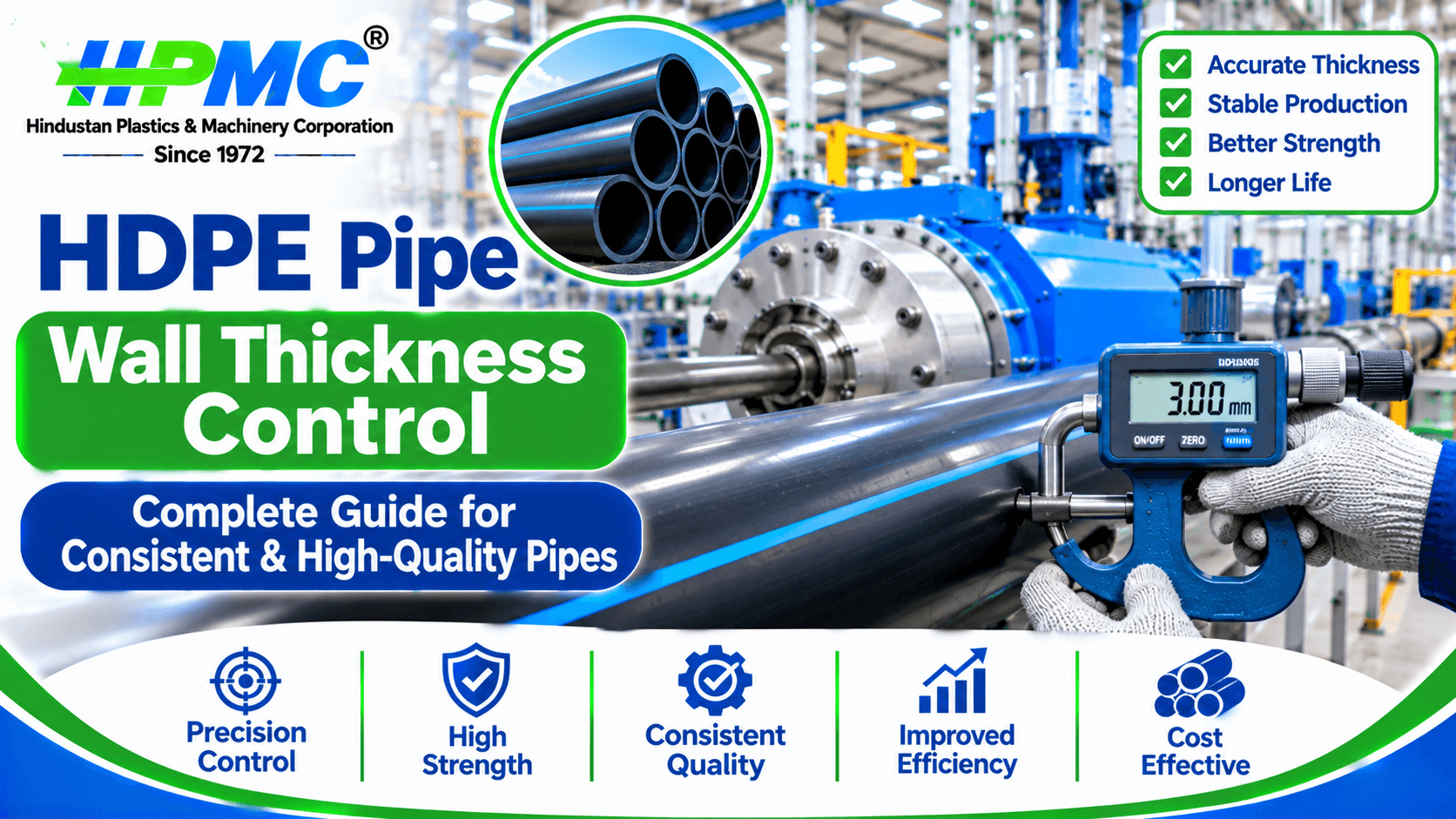
Maintaining consistent wall thickness is one of the most important requirements in HDPE pipe manufacturing. During the extrusion process, even small variations in wall thickness can affect pipe weight, dimensional accuracy, pressure performance and overall product quality. This is why HDPE Pipe Wall Thickness Control plays an important role in modern plastic pipe production.
HDPE pipes are widely used in water distribution, irrigation, drainage, industrial fluid transportation and infrastructure projects. These applications require pipes manufactured according to the relevant dimensional and performance specifications. Manufacturers must maintain proper control over material feeding, extrusion output, die-head performance, vacuum sizing, cooling and haul-off speed to achieve consistent results.
Wall thickness variation can develop because of several reasons, including incorrect die alignment, unstable melt flow, temperature fluctuations, inconsistent material feeding and unsuitable production settings. If these issues are not identified at the right time, they can lead to material wastage, rejected products and unnecessary production costs.
A properly configured HDPE pipe extrusion line, combined with regular dimensional inspection and controlled operating conditions, helps manufacturers maintain the required wall thickness throughout production.
In this guide, we explain the importance of HDPE pipe wall thickness control, the major factors affecting dimensional consistency, common manufacturing problems, inspection methods and practical ways to improve pipe quality.
What Is HDPE Pipe Wall Thickness Control?
HDPE pipe wall thickness control refers to the process of maintaining the required thickness of the pipe wall during manufacturing. It involves monitoring material flow, extrusion conditions, die settings, sizing, cooling and downstream equipment.
The pipe wall must remain within the dimensional tolerances specified for its intended application and applicable product standard.
Wall thickness is influenced by the relationship between the amount of molten polymer delivered through the die and the speed at which the pipe moves through the extrusion line.
If material output increases without a corresponding change in pulling speed, the wall may become thicker. Similarly, if the haul-off speed increases while material output remains unchanged, the wall may become thinner.
Therefore, manufacturers need to maintain proper synchronization between extrusion output and downstream equipment.
Why Is Wall Thickness Control Important in HDPE Pipe Manufacturing?
1. Maintains Pipe Strength
Wall thickness contributes to the structural performance of an HDPE pipe. Consistent dimensions help manufacturers produce pipes according to the required design specifications.
2. Supports Pressure Performance
For pressure applications, wall thickness is an important dimensional parameter. Manufacturers must ensure that the pipe meets the relevant pressure classification and product standard.
3. Reduces Raw Material Waste
Excessive wall thickness means more material is consumed than necessary. Proper control helps manufacturers avoid unnecessary material usage while maintaining specification compliance.
4. Improves Product Consistency
Consistent wall dimensions help maintain uniformity between production batches and support reliable quality inspection.
5. Reduces Production Rejection
Wall thickness variation can result in products that do not meet the required specifications. Regular monitoring helps identify problems before large quantities of material are affected.
6. Supports Customer Satisfaction
Customers expect HDPE pipes to meet agreed dimensional and performance requirements. Consistent manufacturing quality helps build confidence in the finished product.
Major Factors Affecting HDPE Pipe Wall Thickness
1. Extruder Output Stability
The extruder controls the quantity of molten HDPE delivered to the die head. Fluctuations in material feeding, screw performance or operating conditions can affect the amount of material entering the pipe.
A stable extrusion output helps maintain consistent wall thickness when downstream line speed and other conditions remain controlled.
2. Die Head Alignment
The die head and mandrel are responsible for forming the pipe. Incorrect alignment can result in uneven material distribution around the circumference.
For example, one side of the pipe may become thicker while the opposite side becomes thinner.
Manufacturers should inspect die-head alignment during machine setup and after relevant tooling changes.
3. Melt Temperature
Temperature variations across the extrusion process can influence material flow and melt behaviour.
If processing conditions are unstable, the polymer may not flow consistently through the die. The temperature profile should therefore be maintained according to the HDPE material grade and machine manufacturer's recommendations.
4. Screw Speed
Screw speed influences material conveying and processing. Changes in RPM can affect extrusion output, depending on the screw design, material properties and operating conditions.
Operators should monitor screw speed and compare it with actual production output.
5. Material Feeding
Inconsistent raw material feeding can create fluctuations in extrusion output. Feeding equipment should supply the extruder consistently according to the required production conditions.
6. Vacuum Sizing
Vacuum sizing helps control the external diameter of the newly extruded pipe. Incorrect vacuum conditions, sizing sleeve problems or unstable calibration can affect pipe dimensions.
7. Cooling System Performance
Uneven or insufficient cooling can affect dimensional stability. The cooling arrangement should be suitable for the pipe diameter, wall thickness and production speed.
8. Haul-Off Speed
The haul-off unit pulls the pipe through the downstream sections. Its speed must be coordinated with extrusion output to maintain the required dimensions.
9. Raw Material Properties
Different HDPE grades and formulations may have different processing characteristics. Manufacturers should maintain suitable material identification and consistent raw material handling.
10. Machine Condition
Wear in screws, barrels, die components and downstream equipment can influence production stability. Regular inspection helps identify mechanical conditions that may contribute to dimensional variation.
How to Maintain Consistent HDPE Pipe Wall Thickness
1. Maintain Stable Extrusion Output
Monitor the extruder operating conditions and verify that material feeding remains consistent. Sudden changes in output should be investigated before making adjustments to downstream equipment.
2. Check Die and Mandrel Alignment
Inspect the die head and mandrel during setup and maintenance. Ensure that tooling is installed and centred according to the equipment manufacturer's procedure.
3. Monitor Temperature Settings
Maintain a suitable temperature profile across the barrel and die zones. Avoid making unnecessary temperature changes during stable production.
4. Synchronize Extruder and Haul-Off Speed
The extrusion output and haul-off speed should work together. If either changes, operators should check the effect on pipe dimensions and wall thickness.
5. Maintain Proper Cooling Conditions
Check water circulation, spray arrangements, cooling tank performance and temperature conditions. Consistent cooling supports dimensional stability after pipe formation.
6. Inspect the Vacuum Sizing System
Check the sizing sleeve, vacuum connections, water supply and operating conditions. Any irregularity should be investigated before continuing with large production batches.
7. Perform Regular Thickness Measurements
Take measurements at suitable intervals during production. Compare the readings with the required product specifications and maintain inspection records.
8. Follow Preventive Maintenance
Inspect the extruder, die head, sizing system, cooling equipment and haul-off unit according to the manufacturer's maintenance schedule.
Common HDPE Pipe Wall Thickness Problems and Their Solutions
1. Uneven Wall Thickness Around the Pipe
Possible causes: Incorrect die alignment, uneven melt distribution or tooling installation problems.
Solutions: Check die and mandrel centring, inspect the melt distribution and verify tooling condition. Take measurements at multiple positions around the circumference.
2. Wall Thickness Increasing During Production
Possible causes: Changes in extrusion output, reduced haul-off speed or unstable feeding conditions.
Solutions: Compare output and line-speed records. Inspect feeding consistency and check the downstream drive system.
3. Wall Thickness Becoming Too Low
Possible causes: Increased haul-off speed, reduced material output or feeding fluctuations.
Solutions: Review the relationship between material output and pulling speed. Verify that the production settings match the required pipe specification.
4. Thickness Variation Along the Pipe Length
Possible causes: Fluctuating extrusion output, unstable material supply or changes in line speed.
Solutions: Review production trends and inspect the feeding, extrusion and haul-off systems. Compare measurements from different pipe sections.
5. Inconsistent Dimensions After Cooling
Possible causes: Uneven cooling, incorrect vacuum sizing conditions or unstable water circulation.
Solutions: Inspect the cooling tank, sizing sleeve, water distribution and operating settings.
6. Excessive Material Consumption
Possible causes: Consistently producing pipes above the required wall thickness or using unsuitable production settings.
Solutions: Review dimensional inspection records and optimize the production process without going outside the specified tolerances.
How to Measure HDPE Pipe Wall Thickness Accurately
Accurate measurement is essential for checking whether the finished pipe meets its dimensional requirements.
Manufacturers can follow these inspection practices:
- Select a representative pipe sample from the production batch.
- Prepare a clean and properly cut pipe section.
- Use a suitable calibrated wall-thickness measuring instrument.
- Measure at multiple circumferential positions.
- Record the minimum, maximum and individual readings.
- Compare the readings with the applicable product specification.
- Repeat measurements at suitable intervals during production.
Measurements should be carried out using the correct inspection method and instrument for the pipe size and applicable standard.
For better inspection results, manufacturers should also maintain equipment calibration records and document the production conditions associated with each sample.
Role of HDPE Pipe Extrusion Line in Wall Thickness Control
A complete HDPE pipe extrusion line consists of interconnected equipment that influences the final dimensions of the pipe.
The main equipment includes:
1. Raw Material Feeding System
Provides a consistent supply of HDPE material to the extruder.
2. Single Screw Extruder
Melts and plasticizes the polymer before transferring it to the die head.
3. HDPE Pipe Die Head
Shapes the molten polymer into the required pipe dimensions and distributes the material around the pipe circumference.
4. Vacuum Sizing Tank
Helps maintain the required external pipe diameter during the initial forming stage.
5. Cooling Tank
Removes heat from the newly formed pipe and supports dimensional stabilization.
6. Haul-Off Machine
Pulls the pipe through the extrusion line at a controlled speed.
7. Cutting Machine
Cuts the finished pipe into the required lengths.
Each section must operate in coordination with the others. A problem in one section can influence the dimensional stability of the final product.
Manufacturers planning a new production setup can explore HPMC's High Speed HDPE Pipe Plant to understand available HDPE pipe extrusion machinery solutions.
How to Improve HDPE Pipe Production Quality
Maintaining consistent wall thickness requires a complete quality-control approach rather than depending on a single machine setting.
Manufacturers should establish clear inspection procedures, monitor production trends and maintain records for each pipe specification.
Important quality-control practices include:
- Check raw material identification before production.
- Verify machine settings during startup.
- Inspect die and mandrel alignment.
- Monitor extrusion output and screw RPM.
- Check pipe outside diameter and wall thickness.
- Maintain suitable vacuum sizing conditions.
- Inspect cooling water circulation.
- Verify haul-off synchronization.
- Record inspection results for each production batch.
- Follow preventive maintenance schedules.
For additional production planning information, manufacturers can read HPMC's guide on HDPE Pipe Extrusion Line Output Calculation.
Cooling is another important part of dimensional control. A suitable cooling arrangement helps stabilize the pipe after forming. Learn more through HPMC's HDPE Pipe Cooling Tank Selection Guide.
How to Select the Right HDPE Pipe Extrusion Machine
Choosing suitable machinery is important for achieving the required wall thickness and production capacity.
Before selecting an HDPE pipe extrusion machine, manufacturers should evaluate:
- Required pipe diameter range.
- Minimum and maximum wall thickness.
- Material grade and processing requirements.
- Required production output.
- Extruder screw diameter and configuration.
- Die-head design and available tooling.
- Vacuum sizing and cooling arrangement.
- Haul-off capacity and speed control.
- Cutting and pipe collection arrangements.
- Installation, commissioning and technical support.
The complete production line should be selected according to the actual product range and manufacturing requirements.
Manufacturers should also consider finished pipe handling and cutting requirements. For more information, read HPMC's HDPE Pipe Length Measurement Accuracy Guide.
Why Choose HPMC for HDPE Pipe Extrusion Machinery?
Hindustan Plastics and Machinery Corporation (HPMC) has been associated with plastic processing and extrusion machinery manufacturing since 1972.
The company offers machinery solutions for different plastic extrusion applications, including HDPE pipe manufacturing.
When planning an HDPE pipe production facility, manufacturers should evaluate the complete extrusion process, including material feeding, extrusion, die-head configuration, vacuum sizing, cooling, haul-off and cutting.
The right equipment configuration depends on pipe dimensions, wall thickness, production capacity, material grade and manufacturing requirements.
HPMC supports manufacturers in evaluating machinery requirements for their intended production applications. Businesses can discuss their product specifications and equipment requirements with the company before finalizing a production setup.
Conclusion
HDPE Pipe Wall Thickness Control is essential for producing pipes with consistent dimensions, reliable quality and controlled material consumption. Wall thickness depends on several interconnected factors, including extrusion output, die-head alignment, melt temperature, material feeding, vacuum sizing, cooling and haul-off speed.
Manufacturers should monitor these factors throughout production and perform regular dimensional inspections to identify variations at an early stage.
A properly selected HDPE pipe extrusion line, supported by preventive maintenance and consistent quality-control procedures, can help manufacturers achieve stable production and reduce unnecessary material waste.
For businesses planning to improve their HDPE pipe manufacturing process, selecting suitable machinery and maintaining coordination between all production sections are important steps towards long-term manufacturing efficiency.
Contact Hindustan Plastics and Machinery Corporation (HPMC)
If you are planning to establish an HDPE pipe manufacturing plant or improve your existing extrusion production process, HPMC can help you explore suitable machinery solutions. Discuss your required pipe diameter, wall thickness, material grade and production capacity with the technical team. You can also explore the HDPE Pipe Coiler Selection Guide for downstream pipe handling information.
Company: Hindustan Plastics and Machinery Corporation (HPMC)
Address: 5, Category II, DSIDC Industrial Area, Nangloi, Delhi – 110041, India
Phone: +91 95605 96392
Email: info@hindustanplastics.com
Website: https://www.hindustanplastics.com/
Request a Quote: Contact HPMC
Google Business Profile: View HPMC on Google
Contact HPMC today to discuss your HDPE pipe extrusion machinery requirements and find a suitable production solution.
Frequently Asked Questions
Find quick answers to the most common questions about this topic.
HDPE Pipe Wall Thickness Control is the process of maintaining consistent pipe wall dimensions during extrusion to meet the required manufacturing specifications.
Wall thickness influences pipe strength, pressure performance, material consumption and dimensional compliance.
Common causes include incorrect die alignment, uneven melt distribution, inconsistent extrusion output, temperature fluctuations and unstable haul-off speed.
Manufacturers should monitor extrusion output, check die alignment, maintain stable temperature conditions, synchronize haul-off speed and perform regular thickness inspections.
Yes. Changes in screw speed can influence material output and therefore affect wall thickness when downstream conditions remain unchanged.
Incorrect alignment between the die and mandrel can cause uneven material distribution, resulting in thicker and thinner areas around the pipe circumference.
Vacuum sizing helps control the external diameter of the pipe during initial forming and supports dimensional consistency.
Inspection frequency should follow the applicable product standard and factory quality-control procedure. Additional checks may be needed after setup changes or process interruptions.
Yes. Uneven cooling or unsuitable cooling conditions can affect dimensional stability and may contribute to variation in finished pipe dimensions.
A properly configured HDPE pipe extrusion line with suitable extrusion, die-head, sizing, cooling and haul-off systems is important for maintaining consistent wall thickness. The machine should be selected according to the required pipe specifications and production capacity.