
Introduction
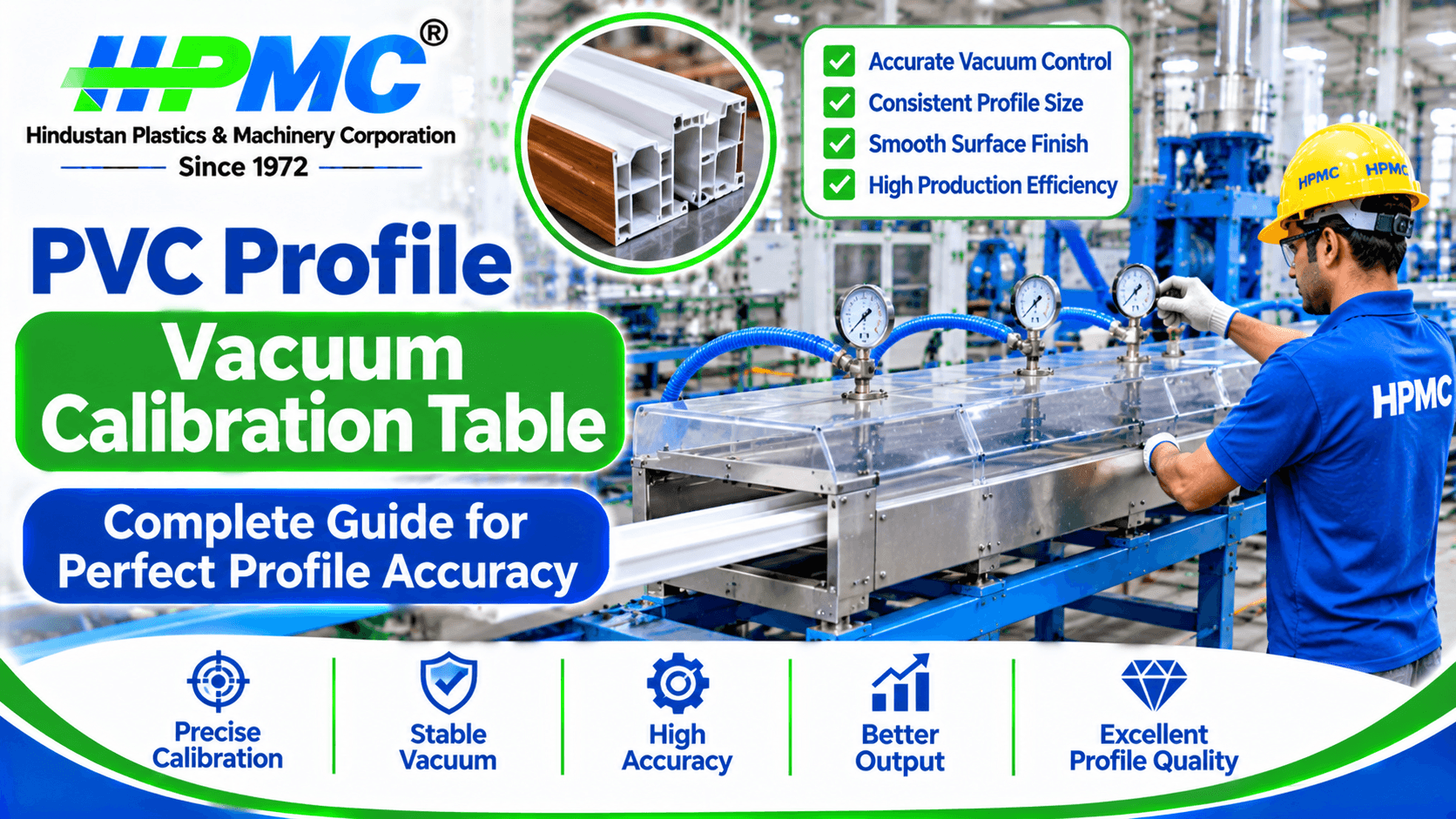
PVC profile manufacturing requires accurate extrusion, proper calibration and controlled cooling to achieve consistent product dimensions and surface quality. One of the most important components in this process is the PVC Profile Vacuum Calibration Table. It helps maintain the required shape and dimensions of an extruded PVC profile immediately after the material leaves the extrusion die.
During extrusion, PVC material is processed inside the extruder and pushed through a specially designed profile die. The hot profile then enters the vacuum calibration table, where controlled vacuum and cooling help maintain its intended cross-sectional shape. This stage is particularly important for manufacturing UPVC window profiles, door frames, decorative profiles and other rigid PVC products.
An unsuitable calibration arrangement can lead to dimensional variations, profile deformation, uneven surfaces and production instability. These problems may increase material wastage and affect the quality of finished products.
For manufacturers, selecting the right vacuum calibration table involves evaluating profile dimensions, calibration length, vacuum capacity, cooling arrangements, table movement and compatibility with the complete extrusion line.
In this guide, we will explain how a PVC profile vacuum calibration table works, its major components, selection factors, common problems, maintenance practices and ways to improve production quality.
What Is a PVC Profile Vacuum Calibration Table?
A PVC Profile Vacuum Calibration Table is a specialised downstream machine used in PVC profile extrusion lines to maintain the required shape and dimensions of a newly extruded profile.
After leaving the profile die, the material is still hot and may deform if it does not receive proper support and cooling. The calibration table provides controlled sizing conditions to help the profile retain its designed cross-section.
The system generally includes a calibration unit, vacuum arrangement, cooling water circulation, supporting structure, adjustment mechanisms and monitoring components.
The main functions include:
- Maintaining the required PVC profile dimensions.
- Supporting accurate cross-sectional geometry.
- Controlling profile deformation after extrusion.
- Providing vacuum-assisted calibration where required.
- Supporting controlled cooling.
- Improving finished profile consistency.
- Maintaining stable downstream production.
The table configuration depends on the profile design, material formulation, production speed and extrusion line requirements.
Why Is a Vacuum Calibration Table Important in PVC Profile Manufacturing?
1. Maintains Profile Dimensional Accuracy
The calibration table helps maintain the required profile dimensions while the material is still hot. Proper calibration supports consistent width, height and cross-sectional geometry.
2. Prevents Profile Deformation
PVC profiles may change shape if they are not adequately supported during the initial cooling stage. A suitable calibration arrangement helps reduce deformation.
3. Improves Surface Quality
Proper calibration and cooling help produce smooth and consistent profile surfaces. This is particularly important for window and door profiles where appearance and fitting accuracy matter.
4. Supports Stable Production
A properly configured table helps maintain consistent processing conditions and reduces interruptions caused by calibration-related problems.
5. Reduces Material Rejection
Dimensional variation and profile deformation can result in rejected products. Suitable calibration equipment helps manufacturers maintain production quality.
6. Improves Manufacturing Efficiency
An efficient calibration arrangement supports continuous extrusion and helps maintain coordination between the extruder, cooling system and haul-off.
Main Components of a PVC Profile Vacuum Calibration Table
1. Calibration Fixtures
Calibration fixtures support the required cross-sectional dimensions of the PVC profile. Their design must match the specific profile being manufactured.
2. Vacuum System
The vacuum system creates controlled negative pressure in the calibration arrangement. Depending on the design, vacuum helps draw the hot profile against the calibration surfaces.
3. Water Cooling System
Cooling water helps remove heat from the newly extruded PVC profile. Proper cooling supports dimensional stability before the profile moves towards the haul-off unit.
4. Stainless Steel Tank
The tank provides the structure for the calibration and cooling arrangement. Stainless steel construction is commonly selected for components exposed to water and industrial operating conditions.
5. Vacuum Pump
The vacuum pump provides the required vacuum supply. Its capacity and condition should be suitable for the calibration system and operating requirements.
6. Water Circulation Pump
The water circulation pump supports cooling water movement through the required passages and equipment.
7. Adjustment Mechanism
Adjustment arrangements allow operators to position the calibration table according to the extrusion line setup.
8. Control and Monitoring Instruments
Pressure gauges, vacuum indicators and temperature-monitoring instruments help operators observe important operating conditions.
How Does a PVC Profile Vacuum Calibration Table Work?
The vacuum calibration table works as part of a complete PVC profile extrusion line.
1. PVC Material Feeding
The manufacturing process begins with feeding the prepared PVC compound into the extruder.
2. Material Plasticisation
The extruder processes the PVC compound through controlled heating and mechanical action.
3. Profile Formation Through Die
The processed material passes through a customised profile die that creates the required cross-sectional shape.
4. Vacuum Calibration
The hot profile enters the calibration section. The vacuum arrangement helps maintain the designed dimensions and shape.
5. Cooling
Cooling water removes heat from the profile and helps it become sufficiently stable for downstream handling.
6. Profile Haul-Off
The haul-off unit pulls the calibrated profile through the production line at a controlled speed.
7. Cutting
The cutting machine separates the continuous profile into the required lengths.
8. Collection and Inspection
Finished profiles are collected and inspected for dimensional accuracy, surface finish and other product requirements.
Every stage must operate in coordination to achieve consistent manufacturing quality.
Important Factors to Consider When Selecting a PVC Profile Vacuum Calibration Table
1. Profile Size and Design
The first consideration is the type of PVC profile you intend to manufacture. Window frames, door sections, decorative profiles and other products have different cross-sectional designs.
The calibration arrangement must be compatible with the intended profile dimensions.
2. Calibration Length
The required calibration length depends on the profile geometry, material characteristics and production conditions.
Manufacturers should discuss the appropriate calibration arrangement with the machinery supplier instead of selecting equipment only by overall table length.
3. Vacuum Capacity
The vacuum system should provide suitable and stable vacuum conditions for the calibration process.
An unsuitable vacuum arrangement may affect profile sizing and dimensional consistency.
4. Cooling Capacity
Cooling performance is essential for stabilising the profile after extrusion.
The cooling arrangement should match the profile thickness, production speed and material processing requirements.
5. Table Construction
Check the construction quality, structural stability, material selection and accessibility of important components.
Industrial equipment should be designed to withstand regular production conditions.
6. Adjustment Flexibility
The table should provide suitable adjustment facilities for installation and alignment with the extrusion line.
7. Profile Compatibility
Different PVC profiles may require different calibration fixtures. Confirm which tooling arrangements are supported by the proposed machine.
8. Maintenance Accessibility
Check whether vacuum connections, water passages, pumps and other components can be inspected and maintained conveniently.
9. Extrusion Line Compatibility
The calibration table must work with the profile extruder, die, haul-off and cutting equipment.
For an overview of the complete manufacturing system, manufacturers can read HPMC's PVC Profile Machine Manufacturers: Complete Buying Guide.
Common PVC Profile Vacuum Calibration Table Problems and Solutions
1. Profile Dimensional Variation
Possible Causes:
- Incorrect calibration setup.
- Unstable vacuum conditions.
- Inconsistent cooling.
- Incorrect die and calibration alignment.
Solutions: Check profile measurements, inspect vacuum performance and verify alignment between the die and calibration table.
2. Profile Surface Scratches
Possible Causes:
- Damaged calibration surfaces.
- Material deposits.
- Contaminated cooling water.
- Incorrect profile movement.
Solutions: Inspect calibration surfaces, clean the equipment and check the profile movement path.
3. Profile Deformation After Calibration
Possible Causes:
- Insufficient cooling.
- Incorrect haul-off speed.
- Unsuitable calibration arrangement.
- Improper profile support.
Solutions: Review cooling conditions, verify haul-off coordination and inspect the calibration fixtures.
4. Unstable Vacuum Pressure
Possible Causes:
- Vacuum leakage.
- Blocked vacuum passages.
- Pump performance issues.
- Loose connections.
Solutions: Inspect hoses, connections, filters and vacuum passages. Check pump performance according to the manufacturer's maintenance instructions.
5. Uneven Cooling
Possible Causes:
- Inconsistent water circulation.
- Blocked cooling passages.
- Insufficient water supply.
- Improper cooling arrangement.
Solutions: Inspect water circulation, clean the required passages and verify the cooling system's operating condition.
6. Profile Sticking During Calibration
Possible Causes:
- Incorrect calibration dimensions.
- Excessive friction.
- Deposits on calibration surfaces.
- Unsuitable processing conditions.
Solutions: Inspect the calibration surfaces, review tooling dimensions and check material processing conditions.
How to Improve PVC Profile Calibration Accuracy
Maintaining calibration accuracy requires attention to the entire extrusion process rather than adjusting only the vacuum system.
Maintain Proper Die Alignment
The profile die and calibration table should be aligned according to the machine manufacturer's installation instructions.
Monitor Vacuum Conditions
Regularly monitor vacuum indicators and investigate sudden pressure changes.
Maintain Consistent Cooling
Ensure that the cooling arrangement provides suitable and consistent water circulation.
Coordinate Haul-Off Speed
The haul-off speed should be matched with extrusion output. Incorrect pulling conditions may cause profile stretching or deformation.
Inspect Calibration Fixtures
Check fixtures for wear, deposits and surface damage.
Measure Finished Profiles
Regularly measure profile width, height and other important dimensions against the approved drawings.
For more information about PVC extrusion equipment and processing, explore HPMC's Conical Twin Screw Plant for PVC Profile.
PVC Profile Vacuum Calibration Table Maintenance Checklist
Preventive maintenance helps maintain equipment performance and reduce unexpected production interruptions.
Daily Maintenance
- Check vacuum pressure indicators.
- Inspect visible water connections.
- Check for leakage around hoses.
- Observe water circulation.
- Inspect calibration surfaces.
- Check the table's alignment visually.
Weekly Maintenance
- Inspect vacuum hoses and fittings.
- Check pump operating conditions.
- Clean accessible cooling passages.
- Inspect water filters where fitted.
- Check adjustment mechanisms.
- Inspect electrical connections.
Periodic Maintenance
- Inspect calibration fixtures for wear.
- Examine pump and motor condition.
- Check structural fasteners.
- Inspect the cooling system thoroughly.
- Verify monitoring instruments.
- Maintain service and inspection records.
Always follow the machinery manufacturer's maintenance recommendations and isolate equipment before carrying out maintenance work.
Benefits of Using a Proper PVC Profile Vacuum Calibration Table
A suitable calibration table can provide several benefits:
- Improved profile dimensional accuracy.
- Better cross-sectional stability.
- Consistent surface finish.
- Reduced profile deformation.
- Improved cooling control.
- Better production consistency.
- Reduced calibration-related rejection.
- Improved extrusion line efficiency.
Actual results depend on the machine configuration, material formulation, profile design and operating conditions.
How to Choose the Right PVC Profile Extrusion Line
The vacuum calibration table should be selected as part of the complete PVC profile manufacturing system.
Before purchasing equipment, manufacturers should evaluate:
- Required PVC profile designs.
- Profile width, height and wall thickness.
- Material formulation.
- Required production output.
- Extruder configuration.
- Profile die requirements.
- Vacuum calibration arrangement.
- Cooling system capacity.
- Haul-off and cutting requirements.
- Automation and technical support.
A complete PVC profile extrusion plant may include a conical twin screw extruder, profile die, vacuum calibration table, cooling arrangement, haul-off, cutting machine and stacking system.
Manufacturers producing UPVC window and door profiles should also review HPMC's Window Profile Machine Manufacturers: Complete Guide.
Selecting the complete line according to actual production requirements helps avoid compatibility problems between individual machine sections.
Conclusion
PVC Profile Vacuum Calibration Table is an essential component of modern PVC profile extrusion manufacturing. It helps maintain the required cross-sectional dimensions, supports profile stability and contributes to consistent finished product quality.
Manufacturers should consider calibration design, vacuum capacity, cooling performance, table construction, profile compatibility and maintenance accessibility before selecting equipment.
Regular inspection of calibration fixtures, vacuum connections, water circulation and alignment can help reduce production problems and maintain stable operating conditions.
Most importantly, the vacuum calibration table should be properly matched with the profile die, extruder and haul-off system. A well-coordinated extrusion line supports better dimensional control, improved surface quality and more reliable production.
Contact Hindustan Plastics and Machinery Corporation (HPMC)
If you are planning to establish a new PVC profile manufacturing plant or upgrade your existing extrusion setup, Hindustan Plastics and Machinery Corporation (HPMC) can help you explore suitable PVC profile extrusion machinery solutions.
HPMC offers machinery solutions for plastic extrusion applications. Discuss your profile design, production capacity, material requirements and calibration specifications with the technical team to understand a suitable equipment configuration.
Company: Hindustan Plastics and Machinery Corporation (HPMC)
Address: 5, Category II, DSIDC Industrial Area, Nangloi, Delhi – 110041, India
Phone: +91 95605 96392
Email: info@hindustanplastics.com
Website: https://www.hindustanplastics.com/
Request a Quote: Contact HPMC
Google Business Profile: View HPMC on Google
When contacting HPMC, share your required PVC profile dimensions, profile drawings, material formulation, expected production capacity and existing machine configuration.
Contact HPMC today to discuss your PVC profile extrusion machinery requirements and request a suitable quotation.
Frequently Asked Questions
Find quick answers to the most common questions about this topic.
A PVC profile vacuum calibration table is a machine used after the extrusion die to help maintain the required dimensions and shape of hot PVC profiles through controlled calibration and cooling.
Vacuum calibration helps maintain profile geometry, dimensional accuracy and shape stability while the extruded material cools.
The main components may include calibration fixtures, vacuum pump, vacuum connections, cooling water system, circulation pump, stainless steel tank and adjustment mechanisms.
Dimensional variation can result from incorrect calibration, unstable vacuum, inconsistent cooling, die misalignment or unsuitable haul-off speed.
Vacuum conditions influence how the hot profile is held against the calibration surfaces. Unsuitable vacuum conditions may contribute to dimensional inconsistencies or profile deformation.
Basic inspections should be performed regularly, while detailed maintenance should follow the machine manufacturer's recommended schedule and actual operating conditions.
This depends on the table design, available calibration fixtures and profile dimensions. Different profiles may require different calibration tooling.
Cooling water helps remove heat from the extruded PVC profile and supports dimensional stabilisation during production.
Manufacturers should maintain proper die alignment, stable vacuum conditions, consistent cooling, suitable haul-off speed and regular dimensional inspections.
Important factors include profile dimensions, calibration length, vacuum capacity, cooling arrangement, table construction, tooling compatibility, maintenance requirements and technical support.